 .
. .
. .
. .
.
A long neck woman in Huay Pu Keng, near Mae Hong Son, Thailand
In Mae Hong Son, a little town in the hills near the Myanmar border, we took a boat ride down the river to a Karen village. This place was home to refugees from Burma, the hill tribe where the women wear heavy metal rings around their necks which weigh down their shoulders and collar bone to the point where their necks look elongated. While I love meeting indigenous people and seeing their homes and culture, I had some mixed feelings while wandering up the path that wound between thatched huts on stilts.
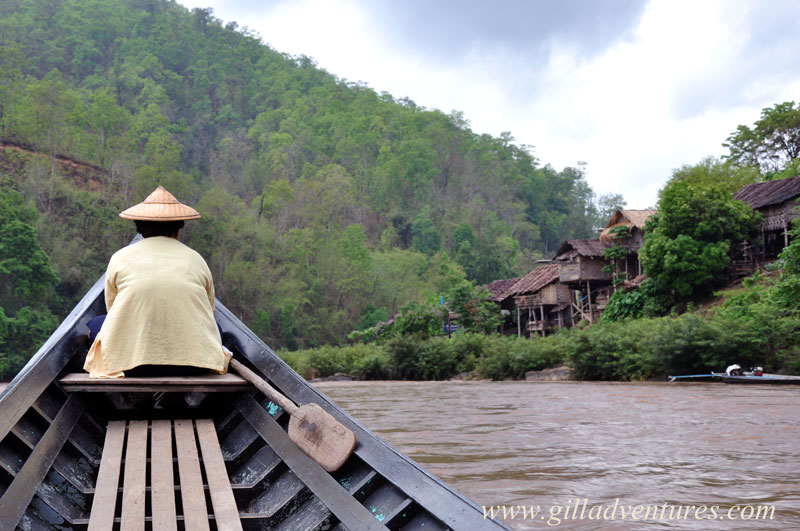
Arriving by boat.
The village was tidy and well kept, with a school at the top. The people of this particular tribe, being from Burma cum Myanmar, are not Thai citizens and cannot get jobs and work in Thailand. They rely on the surrounding jungle and tourists for their income, women and children set up tables of crafts and souvenirs to sell, and there were donation boxes for the community fund and the school, I am sure these help quite a lot. We dropped several coins in each and left with more scarves and jewelry than we arrived with, in our attempt to help the local economy.
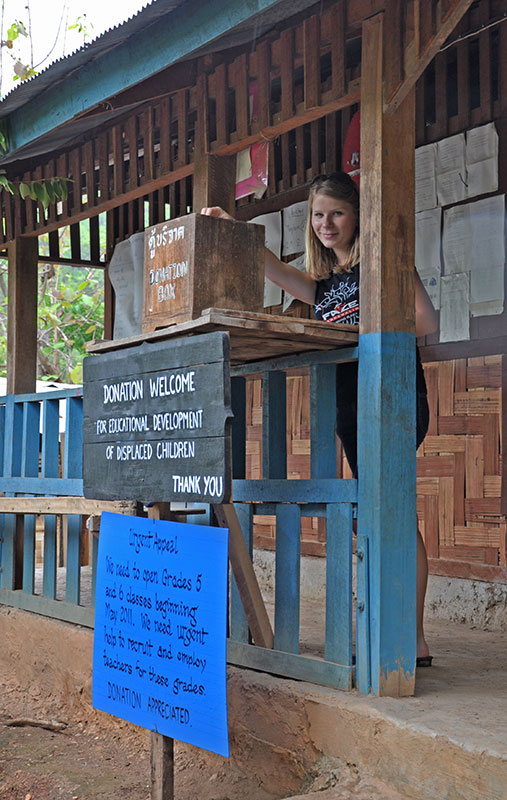
Making a donation
We would have liked to understand more about their homes and culture. We did watch older boys carving sticks from reeds that we suspect will become the supporting framework for the thatch panels made of broad leaves rather than grass or palm fronds. Men showed up in long tail river boats with large pieces of bamboo and carried them up the hill, we wondered how these would be used. A woman sat in the shade in front of her house weaving on a loom. Without an interpreter, we could only see, if not understand.
The people were friendly, and seemed glad we were there, at least on the surface. Some had a sadness in their eyes that shook me. There were several women wearing the heavy neck rings, one we talked with for a while. Her neck rings were five kilos, she let us hold one that was only two kilos but still seemed very heavy, and put a fake one on our necks for photos.
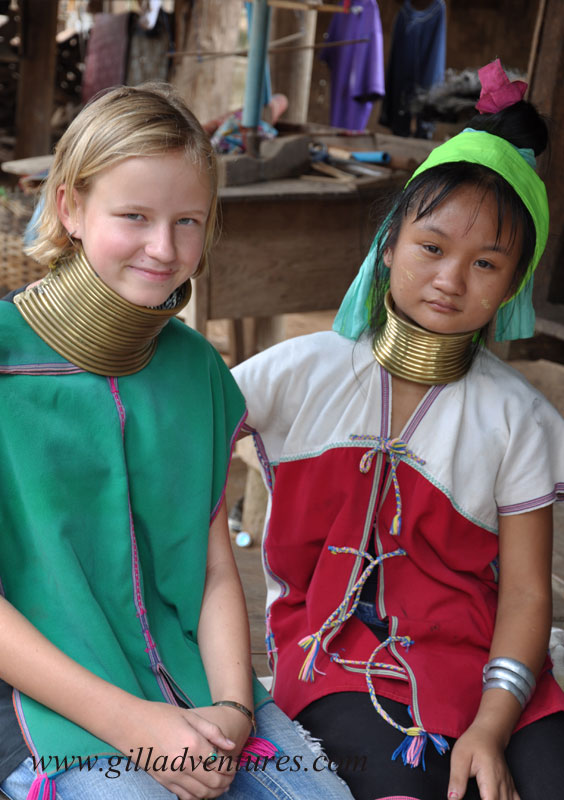
A Karen girl of 14 posing for a photo with our younger daughter.
I’ve read that the practice of wearing the rings was fading. While not as extreme as Chinese foot binding, it does alter the body for some ideal of beauty. We are all familiar with various body art and wearing things that alter the shape of our bodies, even in Western cultures. Piercings, disks and plugs stretching out earlobes, tattoos, and high heeled shoes. The latter will press the toes together, altering the natural shape of the foot if too tight and worn too long.
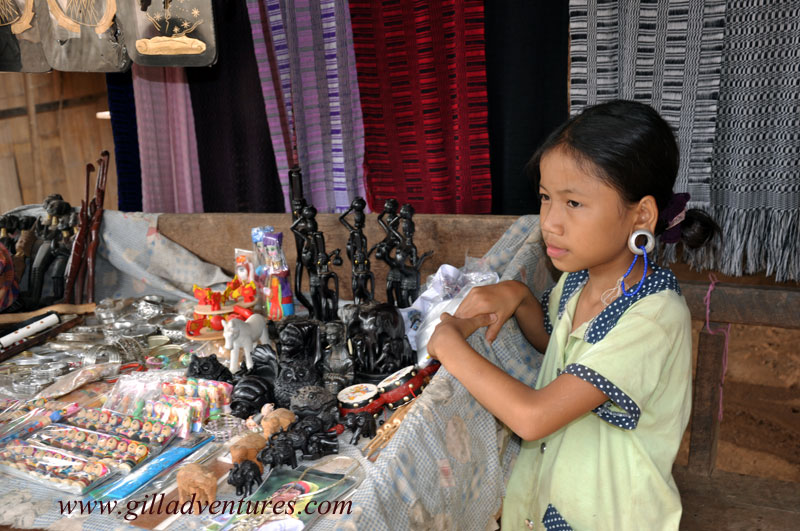
In this village, some of the girls had neck rings, others did not. It made me wonder how much the tourism was a driving force behind the younger generation putting the rings on their necks, as opposed to a sense of tradition and aesthetic springing from themselves. Wearing the rings because tourists value it is not the same as the San Bushmen wearing their traditional clothing when we walked with them in the Kalahari. The San can hang their garb back up and don jeans when they want to. These neck rings are a lifelong commitment. If the girls in this village are made to wear the rings for income, I find that unpalatable.
That said, being a tourist attraction has provided the village with what might be a much better future than they had in the hills of Myanmar. The huts were all in good repair, the path up the middle was cement, not mud. Children were writing out lessons, receiving at least some education. There were big signs up that the village needed a teacher for the older children. Finding one in a place where visitors will see the signs is more likely than a village by the river without outsiders.
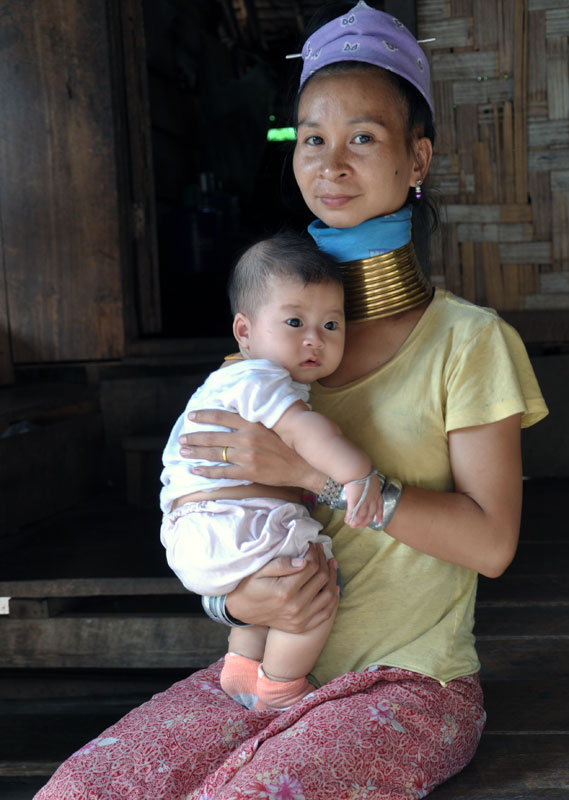
As I said, the experience gave me mixed emotions. It is certainly nothing so extreme as beggars who have enough musical talent to become street musicians being blinded to incite pity (even in Chaing Mai there were a whole line of blind street musicians performing at the Sunday market.) We enjoyed our glimpse into the lives of other people. But, I found myself with a nagging question: is it disfigurement for income or tradition?



Nobody cares.